Bookcase wall vs. pressurized wall in a NYC apartment
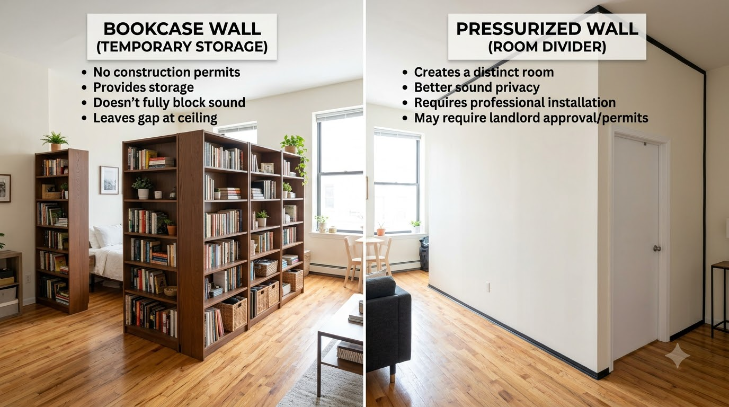
Choosing between a bookcase wall and a pressurized wall comes down to one question. Do you need storage, or do you need privacy? A pressurized wall starts from $2,250 and gives you a real bedroom. A bookcase wall starts from $3,250 and gives you a wall plus built-in shelving.
Both walls are removable. Both leave zero damage. Both are legal in most NYC rental apartments. But they're built differently, they look different, and they suit different situations. This guide shows you when to pick each one, so you don't pay for the wrong wall.
Bookcase Wall vs Pressurized Wall NYC: Quick Comparison
| Feature | Bookcase Wall | Pressurized Wall |
|---|---|---|
| Starting Price | From $3,250 | From $2,250 |
| Height | Floor to ceiling | Floor to ceiling |
| Built-in Storage | ✓ Yes — shelves included | ✗ No storage |
| Privacy | Good — solid wall face | Excellent — sealed, with door |
| Soundproofing | Add-on available (+$350) | Add-on available (+$350) |
| Landlord Approval | Easier — looks like furniture | Usually approved — confirm first |
| Removal | Quoted at the site measure | Quoted at the site measure |
| Best For | Studios, living-room divides | New bedrooms, home offices |
What Is a Bookcase Wall in NYC?
A bookcase wall is a floor-to-ceiling partition with built-in shelving on one side. Instead of a flat drywall surface, the room-facing side becomes a working storage unit. Open shelves, closed cabinets, or a mix of both.
These walls are popular in studios and open-plan apartments across Manhattan, Brooklyn, and Queens, where every inch of floor space has a job. You gain a room divider and a piece of furniture in one installation. For a full look at what's included, see our bookcase walls service page.
Bookcase walls are also the easiest option to get past a co-op board or strict building management. The shelving side faces your living space, so it looks intentional, not like a construction project. Most building managers approve them without much back-and-forth.
Bookcase Wall: Pros and Cons
✓ Advantages
- Built-in storage — no separate bookshelf or wardrobe needed
- Traditional, furniture-like look that landlords and co-op boards prefer
- Customizable shelf heights and finishes
- Works well in narrow studios in the West Village, Astoria, or Inwood
- Doubles as a display wall for books, plants, and décor
✗ Drawbacks
- Higher starting price than a pressurized wall
- Longer installation than a standard pressurized wall
- Heavier, so removal takes a bit more time
- Not the best choice if creating a true bedroom is the goal
What Is a Pressurized Wall in NYC?
A pressurized wall is a floor-to-ceiling partition held in place by an internal pressure system. No nails, no screws, no damage to your apartment. Once it's up, it looks and feels like a standard drywall partition. Most people can't tell the difference.
Pressurized walls are the most common temporary wall type in New York City. They install fast and remove fast, with no patching needed afterward. Your security deposit stays intact. See our full pressurized walls service page for configuration options.
If your goal is to split a Manhattan apartment with a roommate and cut your monthly rent, a pressurized wall is almost always the right choice.
Pressurized Wall: Pros and Cons
✓ Advantages
- Fast install for most NYC apartments
- Seamless finish available — painted to match your walls exactly
- Lowest starting price at $2,250
- Zero damage on removal — deposit fully protected
- Works in almost every building type, from Harlem brownstones to Midtown high-rises
✗ Drawbacks
- No built-in storage — you'll need separate furniture for the new room
- Can creak slightly in buildings with uneven ceilings
- Not suitable for buildings that prohibit any ceiling contact
Bookcase Wall vs Pressurized Wall NYC: 2026 Cost Breakdown
Pricing depends on wall size, door type, and add-ons. Here are our current published rates across all five boroughs.
| Wall Type | Starting Price | Notes |
|---|---|---|
| Pressurized wall | From $2,250 | 8 ft ceiling, up to 12 ft wide, standard door included |
| Bookcase wall | From $3,250 | Includes built-in shelving |
| + Soundproofing | +$350 | Flat rate, either wall type |
| + Door upgrade | +$300 to +$750 | Pocket sliding $300, single French $450, pocket French $750 |
| + Seamless finish | +$450 | Flat rate, either wall type |
The bookcase wall costs more upfront. But it replaces a piece of furniture you'd have bought anyway. In a small Williamsburg studio, that trade-off often makes sense. For a full breakdown of every cost variable, see our guide to temporary wall cost in NYC.
Not sure which wall fits your apartment?
We install both types across all five boroughs. Most clients get a quote within the hour.
📞 Call or text: +1 917-789-5537
Get a Free Quote →Which Wall Should You Choose for Your NYC Apartment?
The right choice depends on your goal, not just your budget. Use these rules and you'll get it right the first time.
📚 Choose a bookcase wall if…
- You're dividing a living room or open-plan studio
- Storage is tight and every square foot matters
- Your co-op board prefers a furniture-like look
- You want the new wall to feel like a designed part of the apartment
🏠 Choose a pressurized wall if…
- You're creating a new bedroom or private home office
- Splitting rent with a roommate is the goal
- You need the fastest install available
- Protecting your security deposit is the top priority
Still unsure? A good installer will visit your space and give you an honest recommendation before you commit to anything. That visit is free.
Soundproofing: Does It Matter Which Wall Type You Choose?
Both walls support soundproofing as an add-on. The difference is how well each type seals by default, before you add any insulation.
A pressurized wall seals tightly from floor to ceiling and includes a door. Sound doesn't travel around the edges. A bookcase wall also reaches the ceiling, but the shelf openings on the room-facing side let some sound pass through. If privacy is critical, like a bedroom shared with a roommate, the pressurized wall performs better as a baseline.
Add mineral wool soundproofing insulation to either wall type for a flat $350. With insulation, both walls achieve solid acoustic separation for everyday apartment use. The NYC Department of Buildings doesn't require a specific sound rating for temporary walls. For the NYC DOB's guidance on residential partitions, see the official NYC Department of Buildings page.
Do You Need Landlord Approval in NYC?
Yes. Get written approval from your landlord before installing either type of wall. This protects you if questions come up at move-out.
In practice, most NYC landlords approve both wall types without issue. Bookcase walls often get approved faster, since they look like furniture. Pressurized walls are also widely accepted, but some buildings, particularly pre-war co-ops on the Upper West Side or in Park Slope, have stricter rules about ceiling contact.
If your landlord refuses both options, a freestanding wall is the next best choice. It stops just below the ceiling, which means it meets the rules of virtually every building in New York City. For more on building compliance, see our FAQ page.
Popular Add-Ons for Both Wall Types
Both bookcase walls and pressurized walls support the same add-on options. Here are the most common upgrades our NYC clients request:
- Doors: French doors, sliding doors, hinged, or pocket doors — $300 to $750 depending on style
- Soundproofing: Mineral wool insulation panels — flat $350
- Windows: Pass-through or fixed glass panels — keeps light moving between rooms
- Seamless finish: Skim-coated, painted surface that matches your walls — flat $450
- Glass doors: Frosted or clear glass for light and privacy in the same door
Frequently Asked Questions
What is the difference between a bookcase wall and a pressurized wall in NYC?
A pressurized wall is a plain floor-to-ceiling partition held in place by an internal pressure system. No nails, no screws. It includes a door and looks like a standard drywall wall. A bookcase wall is also floor-to-ceiling, but the room-facing side has built-in shelving or cabinets. Pressurized walls offer more privacy. Bookcase walls offer storage and a furniture-like look that landlords and co-op boards tend to prefer.
How much does a bookcase wall cost in NYC?
A bookcase wall in NYC starts from $3,250, with professional installation included. The final price depends on wall width, ceiling height, shelf configuration, and finish. Soundproofing adds a flat $350. A door upgrade adds $300 to $750, depending on style.
Do I need landlord approval for a bookcase wall in NYC?
Yes. Always get written landlord approval before installing any wall, including a bookcase wall. Bookcase walls are usually easier to approve than pressurized walls, since they look like furniture rather than construction. Most NYC landlords and co-op boards approve them on the first request. Getting approval in writing protects your security deposit if questions come up at move-out.
Which wall type gives better soundproofing in NYC?
A pressurized wall gives better baseline soundproofing, since it seals tightly from floor to ceiling with a door that closes fully. A bookcase wall has open shelf faces that let some sound pass through. Both walls support mineral wool insulation as an add-on for a flat $350, which improves sound separation on either type.
Can I add a door to a bookcase wall or pressurized wall in NYC?
Yes. Both wall types support French doors, sliding doors, hinged doors, and pocket doors. A pocket sliding door adds $300. A single French door adds $450. A pocket French door adds $750. Glass doors, frosted or clear, are a common upgrade for apartments where natural light needs to flow between the divided rooms.